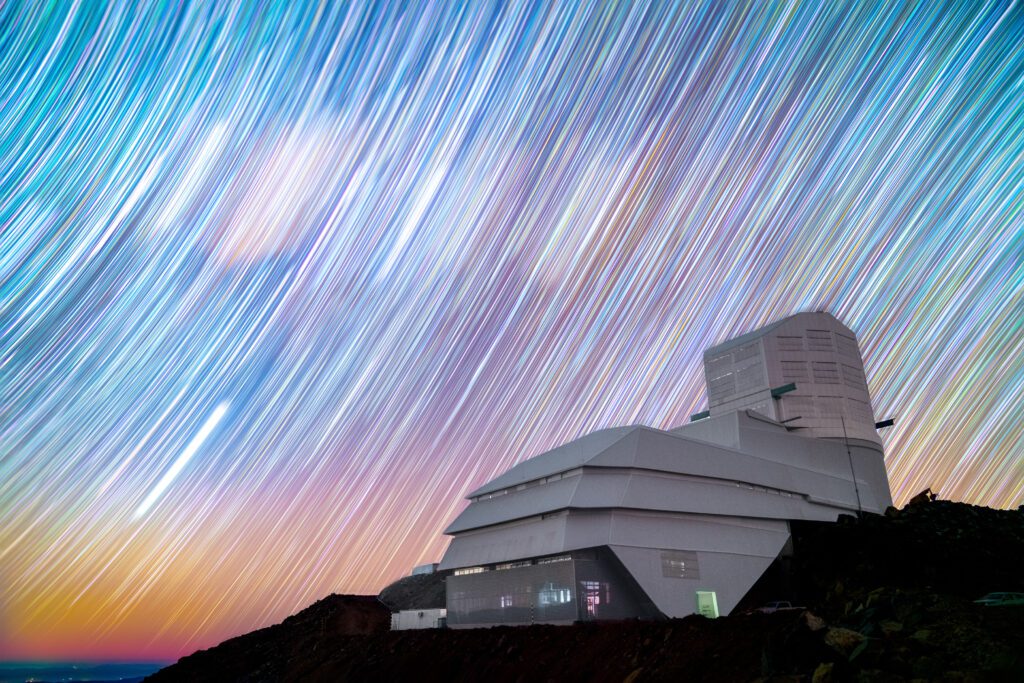
Colorful star trails behind the Vera C. Rubin Observatory in Chile.
[about this photo]

Countless star trails appear as colorful brushstrokes spread across the night sky above NSF–DOE Vera C. Rubin Observatory, jointly funded by the U.S. National Science Foundation (NSF) and the U.S. Department of Energy (DOE) Office of Science. This mesmerizing image was created using long-exposure photography, a technique in which a photographer allows light to enter their camera lens for a period of several minutes to several hours. The camera captures the subject’s movements, and the resulting image shows the flow of time in a single shot. During its decade-long Legacy Survey of Space and Time (LSST) Rubin will use a technique known as difference imaging: equipped with the largest camera ever built, Rubin will image the southern sky every few nights. Scientists will stack these images into ultra-long exposures and create a template image of the southern sky. When this template is compared to individual images, scientists will be able to identify ‘movements’ in the night sky, such as new supernovae or the 'pulsations' of variable stars. After 10 years and thousands of exposures, Rubin will produce an unprecedented ultra-wide, ultra-high-definition, time-lapse record of our Universe — the ultimate movie of the night sky. This image was captured by Hernán Stockebrand, a NOIRLab Audiovisual Ambassador.

Past Event

Vera C. Rubin Observatory Watch Party

Jun. 23, 2025

Monday / 10:00 AM

Event Details

Join the Detroit Observatory and LSA Astronomy in a livestream of the Vera Rubin Observatory First Watch Party!

10:00 AM – Attendees will get a special opportunity to hear from local expert astronomer Michael Meyer, Professor and Chair of Astronomy at U-M.

11:00 AM – Astronomers from the Vera Rubin Observatory in Chile will reveal images from the state-of-the-art Simonyi Survey Telescope that uses one of the largest cameras ever built!

We will also be offering science demos with Detroit Observatory staff and U-M Astronomers!

Check out the Rubin Observatory website for more info!


Register
back to top